
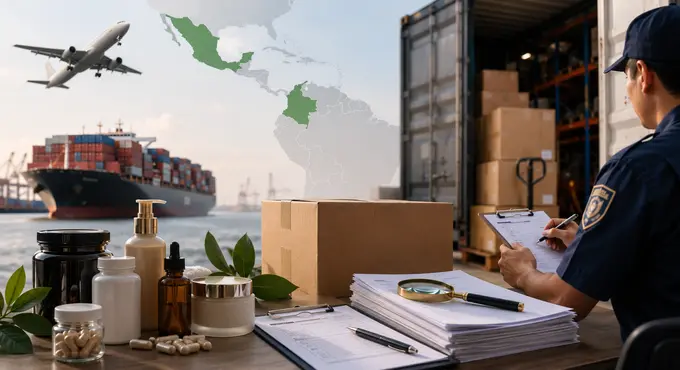
Latin America has become one of the most attractive regions for international Nutra and Beauty brands. Markets such as Mexico and Colombia offer millions of online consumers, growing demand for imported products, and one of the highest adoption rates of Cash on Delivery (COD) in the world.
For many international sellers, generating demand isn’t the hardest part.
Getting products into the country legally, efficiently, and without costly delays is.
Every year, thousands of shipments are delayed, or even rejected, because brands underestimate the complexity of importing regulated products into Latin America.
The good news is that most customs issues are entirely preventable.
Understanding the process before launching your operation can save weeks of delays, thousands of dollars, and countless frustrated customers.
Why Nutra and Beauty Products Receive Extra Scrutiny?
Unlike apparel or consumer electronics, supplements, cosmetics, and personal care products are considered regulated categories in most Latin American countries.
Government agencies closely monitor these products because they are consumed or applied directly to the body.
Customs authorities typically verify:
- Product composition
- Ingredient declarations
- Country of origin
- Product labeling
- Import documentation
- Health registrations (when applicable)
- Product classification
Even minor inconsistencies between your documentation and your shipment may trigger inspections or temporary holds.
This doesn’t necessarily mean your products are prohibited.
It usually means customs needs additional information before releasing the goods.
The Most Common Reasons Shipments Get Stuck
International sellers often assume customs delays are random.
In reality, most delays occur because of predictable operational mistakes.
The most common include:
Incomplete Documentation
Missing invoices, inaccurate packing lists, or inconsistent product descriptions are among the leading causes of customs delays.
Every document should accurately describe the products being imported.
Incorrect Product Classification
Each product must be assigned the correct customs classification.
Misclassification can result in incorrect duties, inspections, penalties, or shipment holds.
Labeling Issues
Many countries require products to include mandatory information in Spanish before entering the local market.
This may include:
- Ingredients
- Manufacturer information
- Batch number
- Expiration date
- Usage instructions
- Warnings
Failing to meet local labeling requirements can delay commercialization even after customs clearance.
Regulatory Requirements
Depending on the product and destination country, certain supplements or cosmetic products may require additional regulatory approvals before importation.
Understanding these requirements early prevents expensive surprises.
Why Many Brands Fail During Expansion?
Marketing teams often focus entirely on customer acquisition.
Media buyers optimize campaigns.
Affiliate managers recruit publishers.
CPA agencies generate leads.
But logistics preparation frequently starts too late.
The result is a painful scenario:
Advertising campaigns are already generating orders while inventory remains stuck at customs.
Customers wait weeks.
Refund requests increase.
Chargebacks grow.
Affiliates lose confidence.
The problem isn’t marketing.
It’s operational readiness.
Import Planning Should Start Before Your First Campaign
Successful international brands prepare logistics before launching advertising.
An effective expansion strategy typically includes:
- Product compliance review
- Documentation validation
- Import planning
- Warehousing strategy
- Inventory forecasting
- Fulfillment processes
- Last-mile distribution
- Returns management
When these elements are aligned, brands can begin selling immediately after inventory arrives.
The Value of a Local Logistics Partner
Managing cross-border logistics remotely is challenging.
A local logistics partner provides much more than warehouse space.
Experienced providers help coordinate multiple stages of the import process while ensuring products move quickly from customs to customers.
Depending on the business model, this may include:
- International freight coordination
- Customs support
- Warehousing
- Inventory management
- Pick and pack
- Order confirmation
- Cash on Delivery operations
- Consegna all'ultimo miglio
- Reverse logistics
Instead of managing several providers independently, brands can operate through one integrated logistics ecosystem.
Inventory Speed Matters More Than You Think
For Nutra and Beauty brands, inventory sitting at customs is more than a logistics issue.
It becomes a marketing problem.
Every delayed shipment affects:
- Advertising ROI
- Customer acquisition costs
- Affiliate performance
- Customer satisfaction
- Brand reputation
- Repeat purchase rates
Fast inventory availability allows campaigns to scale confidently while maintaining a consistent customer experience.
Mexico and Colombia: Similar Opportunity, Different Requirements
Mexico and Colombia are among the largest opportunities for international Nutra and Beauty brands.
However, they should never be treated as identical markets.
Each country has:
- Different customs procedures
- Different regulatory authorities
- Different documentation requirements
- Different delivery networks
- Different consumer behaviors
Brands that adapt their logistics strategy to each market generally achieve faster expansion and fewer operational disruptions.
Compliance Is a Competitive Advantage
Many businesses view compliance as an obstacle.
Successful brands see it differently.
Proper documentation and regulatory preparation create operational stability.
Instead of reacting to customs problems, they prevent them.
This allows marketing teams to focus on growth rather than crisis management.
In highly competitive categories such as supplements and cosmetics, operational excellence often becomes a stronger competitive advantage than advertising alone.
Final Thoughts
Expanding into Latin America offers enormous opportunities for Nutra and Beauty brands, but only when logistics are treated as a strategic investment rather than an afterthought.
Most customs delays are avoidable with the right planning, documentation, and local expertise.
The brands that succeed are not necessarily those with the biggest advertising budgets.
They are the ones that build a reliable supply chain capable of supporting long-term growth.
When your products move smoothly from manufacturer to warehouse, through customs, and finally to your customers, your marketing investment delivers the results it was designed to achieve.
Ready to Expand into Latin America?
Whether you’re launching in Mexico, Colombia, or across multiple LATAM markets, Kiki LATAM helps international brands simplify cross-border logistics with integrated fulfillment, warehousing, customs coordination, Cash on Delivery, last-mile delivery, and reverse logistics.
Speak with one of our logistics specialists today and discover how to expand your Nutra or Beauty business without costly customs delays.