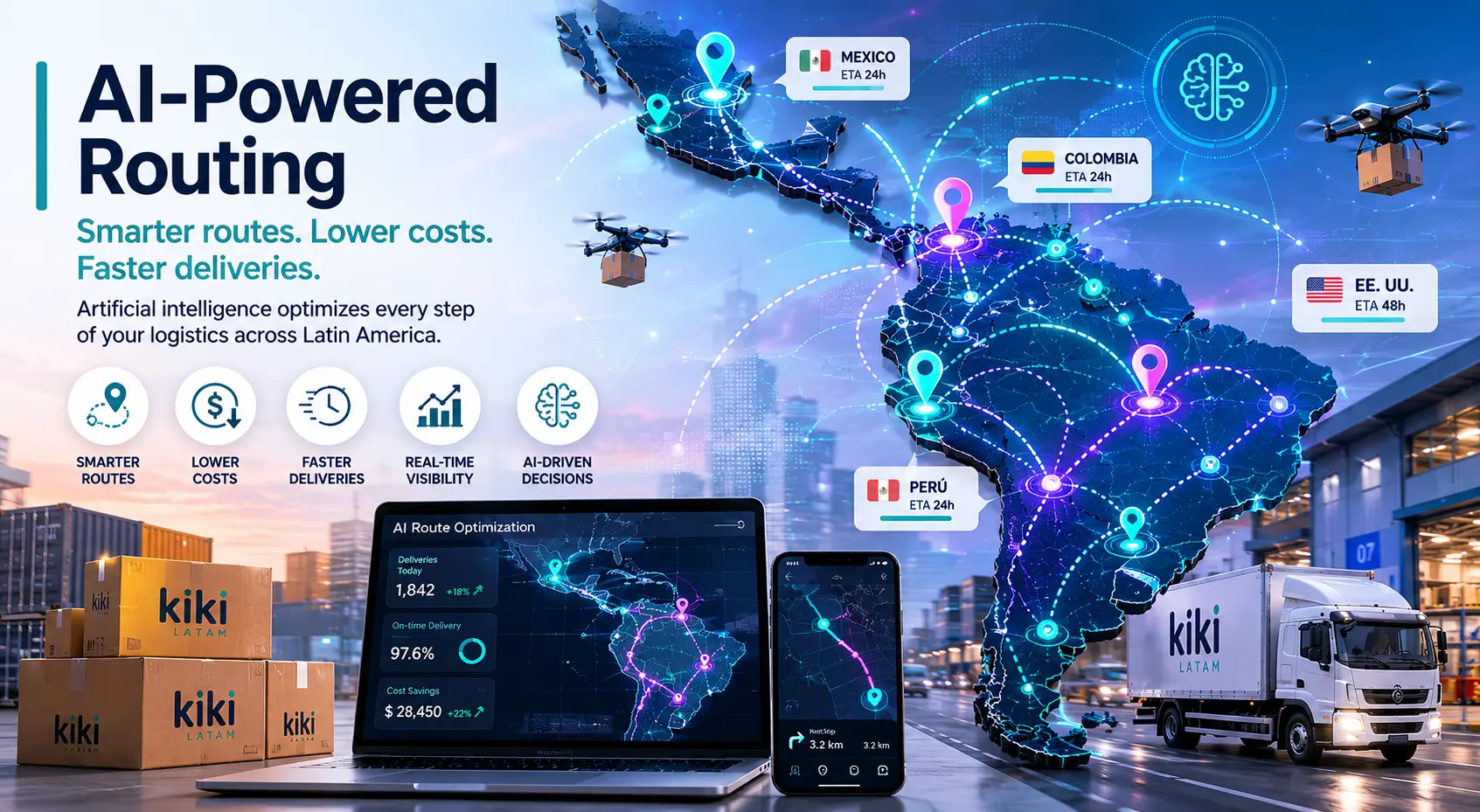
The logistics industry in Latin America is evolving rapidly. As ecommerce continues to grow and customer expectations become more demanding, businesses are under pressure to deliver faster, reduce shipping costs, and improve operational efficiency.
In this environment, AI-powered routing has become one of the most important technologies transforming supply chain and logistics operations across the region.
From last-mile delivery to cross-border logistics, artificial intelligence is helping companies optimize routes, predict disruptions, improve delivery times, and reduce operational costs at scale.
What is AI-powered routing?
AI-powered routing uses artificial intelligence, machine learning, and real-time data analysis to optimize transportation and delivery routes automatically.
Unlike traditional route planning systems, AI routing continuously analyzes:
- Traffic conditions
- Delivery windows
- Driver availability
- Fuel consumption
- Weather patterns
- Order volume
- Geographic constraints
The system then adjusts routes dynamically to maximize efficiency and minimize delays.
For ecommerce brands, marketplaces, retailers, and logistics operators, this technology has become critical for maintaining competitive delivery performance.
Why AI routing matters in Latin America
Logistics in Latin America is significantly more complex than in many developed markets.
Companies operating across countries like Mexico, Colombia, Peru, and Brazil face challenges such as:
- Urban congestion
- Inconsistent infrastructure
- Long delivery distances
- Security risks
- Unpredictable traffic patterns
- Fragmented transportation networks
Traditional logistics models struggle to adapt to this level of operational complexity.
AI-driven logistics allows businesses to make faster and more accurate decisions in real time, improving delivery reliability and operational visibility.
Key benefits of AI-powered routing
- Tempi di consegna più rapidi
- Reduce delivery windows
- Improve same-day and next-day delivery performance
- Increase customer satisfaction
- Riduzione dei costi di trasporto
- Minimizing fuel consumption
- Reducing idle time
- Optimizing vehicle utilization
- Lowering failed delivery attempts
- Real-time operational visibility
- Live tracking
- Predictive ETAs
- Route monitoring
- Delivery performance analytics
- Exception management
- Better last-mile delivery performance
- Optimizing driver allocation
- Grouping deliveries intelligently
- Reducing failed deliveries
- Adapting routes in real time
- Scalability for growing ecommerce operations
- Hot Sale
- Buen Fin
- Cyber Days
- Black Friday
- Holiday campaigns
One of the biggest advantages of AI route optimization is speed.
AI systems can identify the most efficient routes instantly while adapting to changing conditions throughout the day.
This helps companies:
In highly competitive ecommerce markets, faster delivery has become a major differentiator.
Transportation is one of the largest operational expenses in logistics.
AI routing helps reduce costs by:
For companies managing high order volumes, these savings can have a significant impact on profitability.
Modern supply chains require visibility across the entire logistics network.
AI-powered systems provide:
This allows logistics teams to react faster to operational disruptions and improve customer communication.
Last-mile delivery remains one of the most expensive and inefficient parts of the supply chain.
AI improves last-mile operations by:
This is especially valuable in large urban markets with heavy traffic and operational unpredictability.
As ecommerce businesses expand regionally, logistics complexity increases exponentially.
AI routing systems help companies scale operations without proportionally increasing costs or manual coordination.
This becomes critical during peak seasons such as:
How AI is transforming supply chain management
Artificial intelligence is no longer limited to routing alone.
Today, AI is being integrated into:
- Demand forecasting
- Inventory optimization
- Warehouse management
- Fraud detection
- Transportation management
- Customer support automation
The logistics industry is shifting toward predictive and autonomous decision-making systems capable of orchestrating entire supply chain ecosystems.
Companies that adopt AI-driven logistics early are gaining a competitive advantage in speed, cost efficiency, and operational resilience.
The biggest challenges of implementing AI logistics
Despite its benefits, AI adoption in logistics still faces important barriers in Latin America.
Data fragmentation
Many businesses operate with disconnected systems and limited data visibility.
Legacy infrastructure
Older logistics systems are often not designed for real-time optimization.
Operational complexity
Cross-border logistics, customs processes, and multiple transportation partners create integration challenges.
Talent and technology gaps
Many companies still lack internal AI and data capabilities.
This is why businesses increasingly seek logistics partners capable of providing integrated technology and operational orchestration.
Kiki LATAM: Intelligent logistics for modern ecommerce
At Kiki LATAM, we help ecommerce brands, marketplaces, and global sellers scale across Latin America with integrated logistics infrastructure and intelligent operational coordination.
Our solutions combine:
- Adempimento
- Cross-border logistics
- Last-mile operations
- Inventory visibility
- Regional orchestration
- Technology-driven optimization
We help businesses reduce logistics complexity, improve delivery performance, and scale efficiently across Mexico, Colombia, Peru, and the United States.
Ready to optimize your logistics operation with AI-driven solutions?
Contact a Kiki Latam and discover how intelligent routing and integrated logistics can help your business grow faster across Latin America.
- Tag:
- AI logistics ,
- AI-powered routing ,
- Artificial intelligence in logistics ,
- cross-border logistics ,
- Delivery route optimization ,
- ecommerce fulfillment ,
- ecommerce logistics ,
- last-mile delivery ,
- logistics automation ,
- Logistics technology ,
- Predictive logistics ,
- Route optimization ,
- Smart logistics ,
- supply chain optimization ,
- Transportation management