
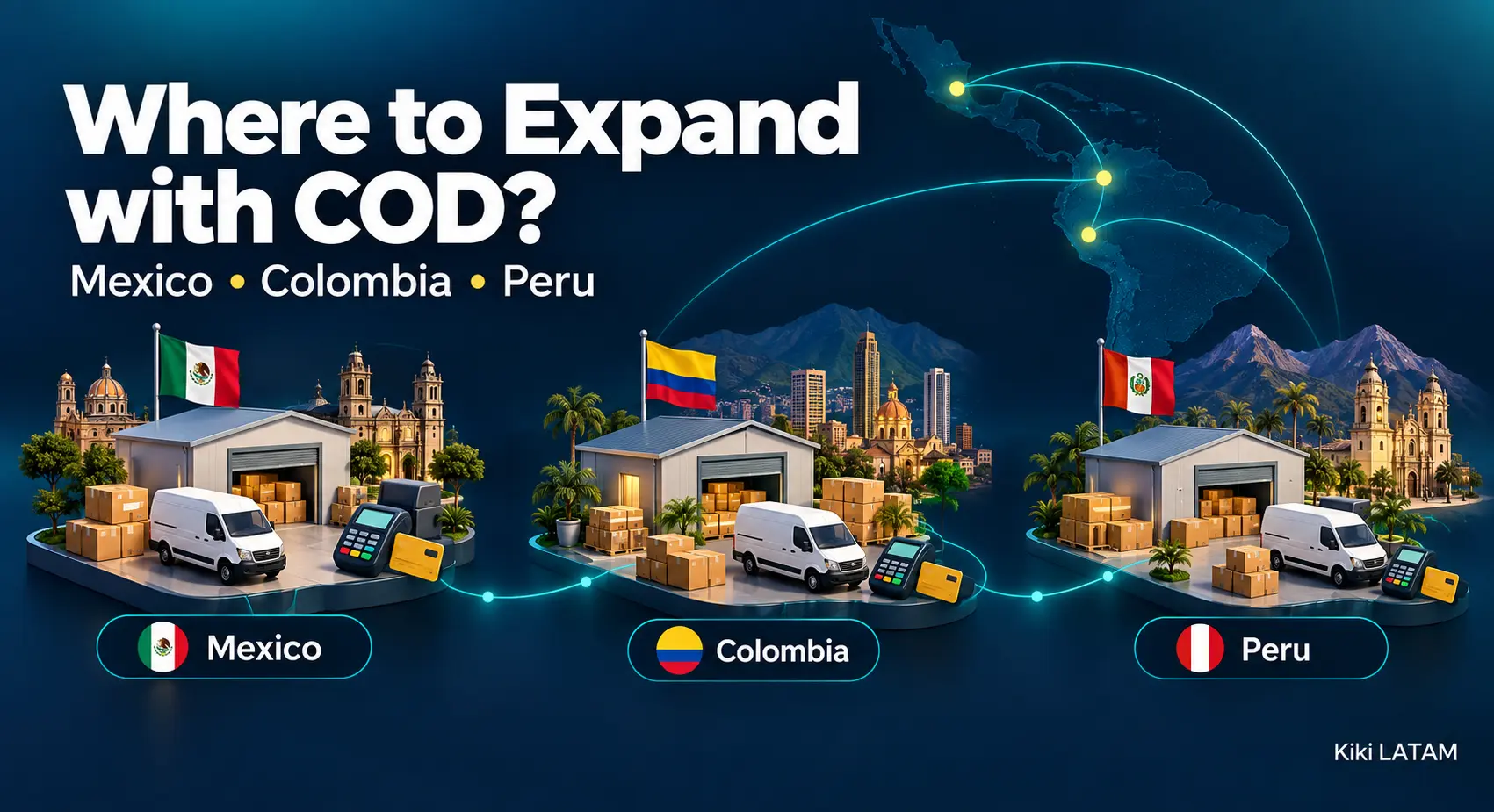
For international D2C brands and CPA businesses, cash on delivery (COD) can help address a familiar challenge: customers want the product, but hesitate to pay before receiving it.
However, offering COD is only the beginning. Profitable expansion depends on confirming orders, delivering successfully, collecting payment, and receiving the proceeds within a predictable timeframe.
Mexico, Colombia, and Peru offer different opportunities. Choosing your first market requires understanding those differences, and building a logistics operation around them.
Mexico: A Strong Candidate for Scale
Mexico offers a substantial digital consumer base. According to AMVO’s 2026 Online Sales Study, retail ecommerce reached MXN 941 billion in 2025, growing 19.2% year over year. AMVO also reports 77.2 million digital buyers.
For businesses with a proven offer and sufficient working capital, this makes Mexico a compelling candidate for expansion.
COD has a place within that opportunity. AMVO’s study found that 14% of surveyed digital buyers reported using cash on delivery for online purchases. This measures reported use, not the share of ecommerce revenue generated through COD.
The practical takeaway is to provide payment flexibility. Some customers may prefer paying upon receipt, while others want to complete payment immediately.
For an initial launch, select delivery zones where your operation can consistently meet its promised service. Position inventory locally, validate addresses before dispatch, and track performance by postal code.
Mexico’s scale creates room to grow, but a larger addressable market does not automatically produce better margins. Expansion should follow evidence from delivered and collected orders.
Colombia: Build Around Confirmation and Flexible Collection
Colombia’s ecommerce activity continues to expand. The Colombian Chamber of Electronic Commerce reported a 22.2% year-over-year increase in digital transactions during the first quarter of 2026. This is a broad ecommerce indicator, rather than a measure of COD demand.
For a COD operation, the key question is how effectively purchase intent becomes collected revenue.
That requires a coordinated process: confirm the customer’s details, explain the amount due, communicate delivery expectations, and manage unsuccessful attempts promptly.
Payment flexibility also deserves attention. Colombia’s Bre-B system enables immediate transfers between participating financial institutions. Its development strengthens the case for considering digital payment options alongside cash, where the logistics workflow supports them.
A customer who chooses COD may primarily want reassurance before paying. Giving that customer an appropriate payment option near delivery can be worth testing.
Colombia is therefore a reasonable market for evaluating an operation built around confirmation, customer communication, and flexible collection. Whether it outperforms Mexico depends on the product, acquisition costs, delivery outcomes, and settlement terms.
Peru: Start with a Focused Operating Area
Peru also has a meaningful digital shopping audience. CAPECE’s 2024–2025 Ecommerce Observatory reports 18.7 million online buyers and an 8.8% ecommerce penetration of retail. These figures describe the wider market, not its COD segment.
A focused pilot in Lima and Callao can provide a practical starting point before broader expansion. Treat this as an operating strategy to validate, rather than proof that these locations will deliver the highest returns.
Define precisely what your delivery and collection service includes. Collecting the product’s full purchase price differs from collecting only the shipping fee. Home delivery also differs from requiring customers to collect parcels at an agency.
Payment preferences are evolving. An April 2026 study from Peru’s central bank found that payment interoperability encouraged movement from cash toward digital channels, with effects varying across districts.
For brands entering Peru, the priority should be a clearly defined service area, suitable payment options, and verified collection procedures.
Compare Collected Margin, Not Just Orders
Public ecommerce statistics provide context, but they cannot identify the most profitable COD market for your brand.
- The country comparison should include:
- Advertising cost per delivered and collected order.
- Confirmation and successful collection rates.
- Fulfillment, delivery, and return costs.
- Time between inventory investment and payment settlement.
Contribution margin by product and delivery zone.
A campaign can generate inexpensive orders while losing money through refusals and returns. Equally, strong sales can put pressure on cash flow if inventory and advertising must be funded long before settlement.
For supplements and beauty products, assess local import, labeling, and product requirements before committing inventory.
Build Your Expansion with Kiki LATAM
Your first market should match your commercial readiness and operating capacity. Mexico offers a strong scale opportunity; Colombia merits consideration for a confirmation-led COD strategy; Peru suits a carefully defined geographic pilot.
Kiki LATAM brings fulfillment, last-mile delivery, COD, and payment collection into your expansion planning. Our team can help assess your products, expected volumes, target locations, and operational needs across these markets.
Talk to a LATAM logistics expert at Kiki LATAM and build an expansion plan around successful deliveries, collected revenue, and sustainable growth.
- Tags:
- Cash on Delivery (COD) ,
- COD Expansion in Latin America ,
- COD Logistics Colombia ,
- COD Logistics Mexico ,
- COD Logistics Peru ,
- cross-border ecommerce ,
- D2C Expansion ,
- ecommerce fulfillment ,
- International Ecommerce Expansion ,
- Kiki LATAM ,
- last-mile delivery ,
- Latin America Ecommerce ,
- Payment collection