
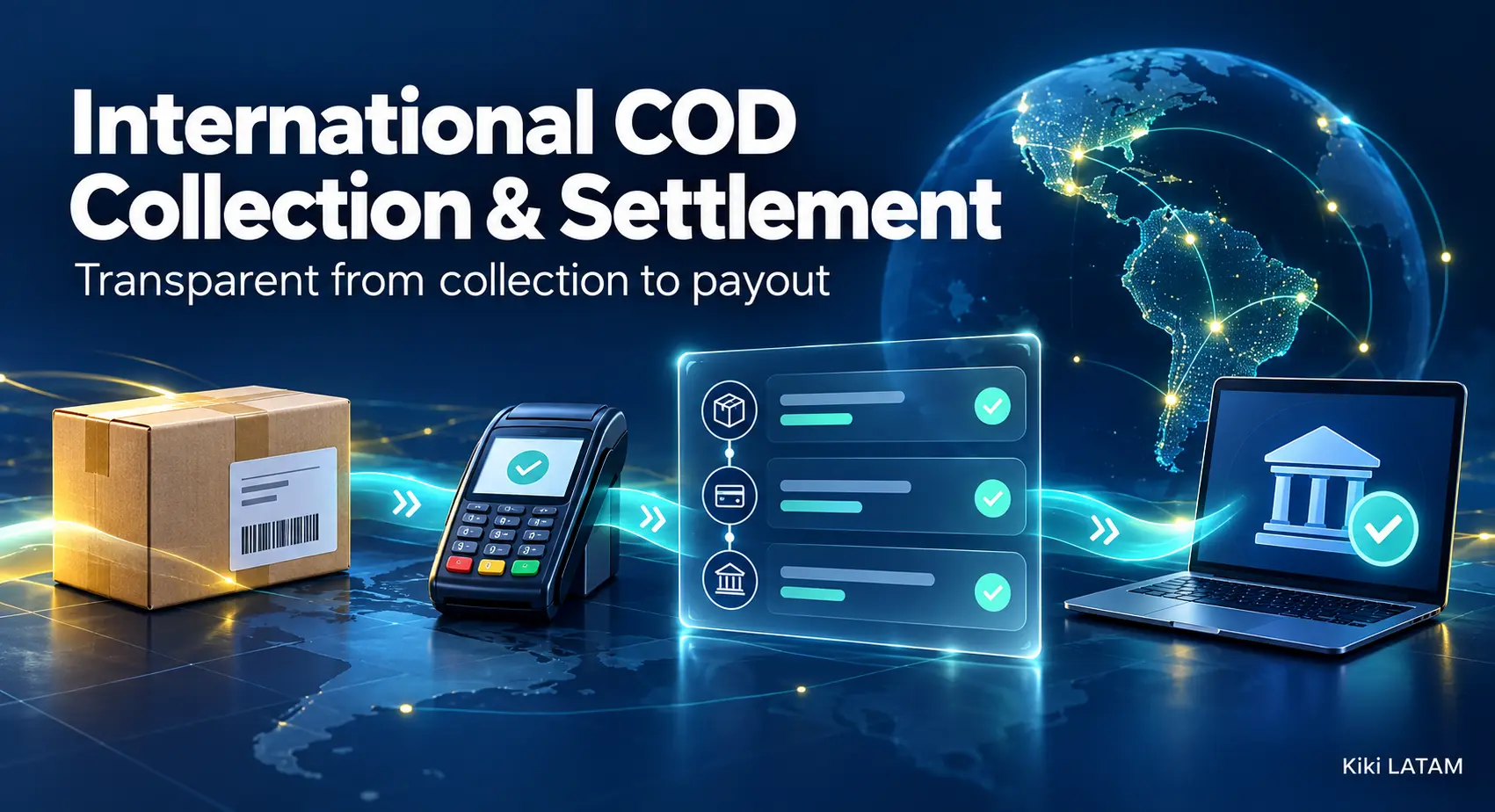
For international CPA businesses and D2C brands, Cash on Delivery (COD) creates an opportunity to sell to customers who prefer paying when their order arrives. But successful delivery is only one part of the transaction.
The buyer’s payment must be recorded, reconciled, included in a settlement, and transferred to the seller. When countries and currencies differ, conversion and banking processes also enter the picture.
Understanding this journey helps businesses forecast cash flow, verify deductions, and evaluate their logistics partner. Kiki LATAM’s published service framework places transparency and traceability at the center of collection, reconciliation, reporting, and transfers.
1. Collection Begins in the Customer’s Market
Customers in Mexico, Colombia, and Peru typically pay in their local currency: Mexican pesos, Colombian pesos, or Peruvian soles.
Depending on the contracted service and location, payment may be collected in cash or through a supported electronic method. The collector records the amount against the corresponding order.
At this stage, three questions matter: Was the order delivered? Was the correct amount collected? Has that payment reached the entity responsible for settlement?
A delivery status alone cannot answer all three. International sellers need financial records connected to operational records.
2. Reconciliation Establishes What Was Collected
Reconciliation connects the expected order amount, the reported collection, and the funds received through the relevant financial channel.
Differences require investigation. A payment might be pending, an amount might have changed, or a customer might have paid through another channel. Refunds and duplicate collections also need clear treatment.
Kiki LATAM’s published terms of service describe management of collection, reconciliation, reporting, and transfer of collected amounts. They also identify detailed reporting on collections, incidents, and transaction statuses.
For a CPA business, this visibility connects campaign-generated orders with financial outcomes. For a D2C brand, it supports forecasting, customer service, and financial control.
3. Settlement Explains the Amount Payable
The amount collected from customers may differ from the amount transferred to the seller.
Depending on the agreement, settlement may include authorized service charges, refunds, adjustments, or other applicable items. Each deduction should have an identifiable basis.
Kiki’s published terms state that collected amounts are transferred after deducting previously agreed fees and charges. This makes the commercial agreement essential to understanding the net payment.
A transparent settlement statement should make the calculation understandable: collections included, deductions applied, outstanding items, and the resulting payable balance.
That balance is not necessarily profit. Product costs, acquisition spending, taxes, and other obligations may still need to be accounted for separately.
4. Settlement Frequency and Account Credit Are Different
“Weekly settlement” can describe a processing schedule without guaranteeing that every collection reaches the seller’s account within seven days.
The timeline may involve a cutoff, reconciliation, invoice approval, payment instruction, and bank credit. Orders collected after a cutoff may enter a later batch.
Kiki’s general terms distinguish weekly COD service invoicing from the transfer process following invoice approval. Businesses should confirm the applicable timing in their service agreement before building cash-flow forecasts.
Ask what starts the settlement clock and which conditions must be completed. Clear timing is more useful than a headline promise without a defined starting point.
5. Currency Conversion Determines the Final Value
An international seller may collect revenue in local currency and receive proceeds in another agreed currency.
Kiki LATAM’s services page describes currency flexibility for international businesses. The available currency, transfer method, and conditions should be established for the particular operation.
Before launch, clarify when conversion occurs, how the exchange rate is determined, and which charges apply. Also confirm whether the receiving account accepts the settlement currency.
Keeping collection, conversion, and transfer amounts distinct helps finance teams explain differences between local sales proceeds and the final account credit.
6. Track the Transfer Through to Receipt
An instructed transfer is not the same as money available to the beneficiary.
Swift explains that payment arrival at the receiving bank and credit to the customer’s account are separate stages. Processing hours, incomplete information, and local requirements can affect completion.
For transfers using Swift, a Unique End-to-end Transaction Reference, or UETR, supports tracking across the payment chain. Other transfer methods use their own references.
Retain the settlement identifier, transfer reference, amount, currency, instruction date, and confirmation of receipt. These records connect the bank payment back to the underlying sales.
7. Establish Responsibilities Before Scaling
Collection does not automatically determine who imports, sells, invoices, or fulfills tax obligations. Those responsibilities depend on the operating structure.
For example, Colombia’s Banco de la República publishes specific procedures for payments involving imports and exports of goods. The correct treatment depends on the transaction being paid.
Confirm the entities involved, the payment beneficiary, required documentation, and the agreed flow before increasing volume.
Build a Transparent COD Operation with Kiki LATAM
Transparency means being able to explain the journey from an individual customer payment to the seller’s settlement and account credit.
Kiki LATAM coordinates collection, reconciliation, reporting, and transfers alongside fulfillment and delivery. Its published framework gives businesses a basis for defining responsibilities, charges, and payment conditions.
Talk to a LATAM logistics expert at Kiki LATAM to establish a collection and settlement process your commercial, operations, and finance teams can understand.