
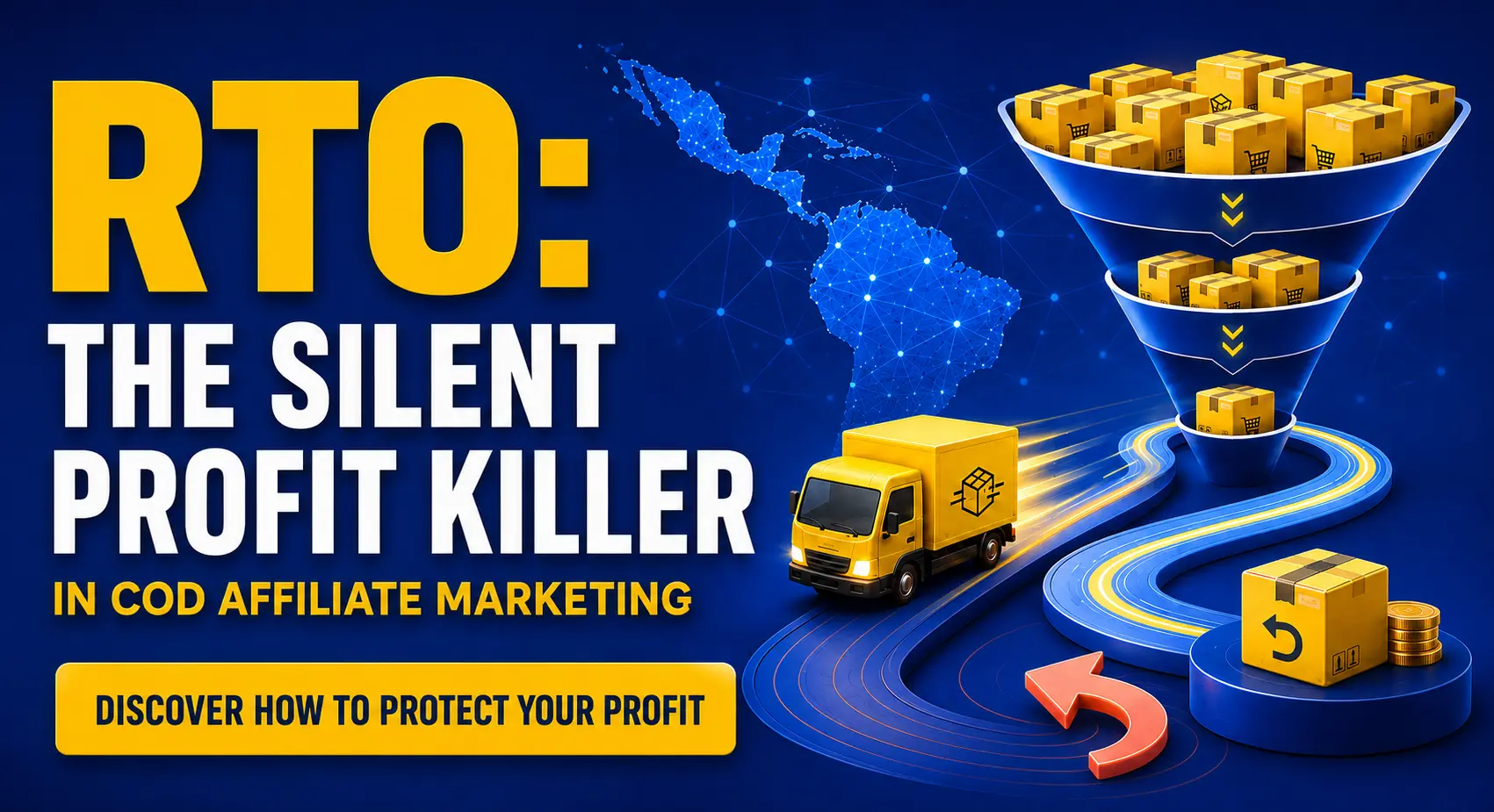
Cash on Delivery can make an offer easier to convert, especially in markets where consumers are reluctant to pay online or do not have access to a credit card. But a high conversion rate at checkout can hide a serious profitability problem: Return to Origin, or RTO.
RTO occurs when a COD order is shipped but cannot be delivered and returns to the warehouse. The customer may reject the parcel, be unavailable, provide an incomplete address or simply deny placing the order. For an Offer Owner, this is not just a lost sale. It is a chain of costs that can turn a promising campaign into an unprofitable operation.
In COD affiliate marketing, the real conversion does not happen when the customer submits the order. It happens when the product is delivered, payment is collected and the revenue becomes available for reinvestment.
Why RTO Is So Expensive for COD Offers
Every failed COD delivery can generate confirmation, picking, packing, outbound delivery, additional attempts, return transportation and warehouse processing costs. It can also immobilize inventory and trigger affiliate commissions calculated on orders that never produced revenue.
This is why cost per lead or cost per order is not enough to evaluate a COD campaign. An Offer Owner may see attractive advertising metrics while losing money after fulfillment and last-mile costs are included.
The more useful metric is cost per delivered order. It connects media performance with confirmation, dispatch, delivery and collection. At Kiki LATAM, we help international Offer Owners and CPA networks connect these stages so they can understand what is actually generating revenue.
The Most Common Causes of RTO
RTO is not a single logistics problem. It results from failures across the post-checkout journey.
1. Low-intent or fraudulent orders
A COD checkout requires little financial commitment. Customers can submit duplicate, impulsive or false orders without paying in advance. If fulfillment starts without validation, the advertiser absorbs the cost.
2. Incomplete or inaccurate addresses
Missing apartment numbers, incorrect postal codes and unclear instructions increase failed attempts, especially when entering a market with unfamiliar address formats.
3. Slow confirmation and dispatch
Buyer intent declines over time. When confirmation or delivery takes too long, customers may forget the order, purchase an alternative product or lose interest before the parcel arrives.
4. Lack of delivery communication
Without delivery notifications, customers may be unavailable or unable to prepare payment. Proactive communication and rescheduling can recover these orders.
5. Poor last-mile allocation
No carrier performs equally in every city or postal code. Using a single provider can reduce delivery rates where another carrier has stronger performance.
How to Reduce RTO in COD Affiliate Marketing
Reducing COD returns requires more than negotiating a lower shipping rate. It requires an operation designed around successful delivery.
Confirm orders before fulfillment
Order confirmation verifies product, price, address and customer intention before dispatch. It can also reveal traffic sources or affiliates producing low-quality orders.
Validate and standardize addresses
Address validation should happen before dispatch. Correcting incomplete information early costs far less than paying for a failed delivery and return.
Use local inventory and fulfillment
Storing products close to demand protects buyer intent. Local fulfillment also simplifies rescheduling, returns and replenishment.
Route orders intelligently
Dynamic routing can select a last-mile provider based on destination, service level, historical performance and cost.
Make rescheduling part of the process
A failed first attempt should not automatically become an RTO. A new delivery window can recover revenue without acquiring another customer.
Measure performance by affiliate and delivered order
CPA networks need visibility beyond approved orders. Offer Owners should compare confirmation rate, dispatch rate, delivery rate, RTO and collected revenue by affiliate, traffic source, product and GEO. This makes it possible to reward real performance and stop scaling traffic that produces orders but not revenue.
How Kiki LATAM Helps Offer Owners Scale COD Profitably
Kiki LATAM provides an integrated operation for companies selling in Mexico, Colombia, Peru and the United States. Our model connects order confirmation, address validation, warehousing, fulfillment, smart carrier assignment, last-mile delivery, rescheduling, COD collection and international settlement.
Instead of coordinating multiple disconnected providers, CPA networks and Offer Owners can manage their expansion through a regional logistics partner and a unified technology layer. Kiki LATAM also supports local production of Nutra and Beauty products in certified laboratories, helping companies reduce cross-border complexity and replenish inventory closer to the target market.
The objective is not simply to ship more parcels. It is to increase the percentage of orders that become delivered and collected sales.
Stop Measuring Orders. Start Measuring Delivered Profit.
RTO is silent because it appears after the advertising platform reports a conversion. By the time the parcel returns, the media budget, fulfillment work and delivery costs have already been incurred.
For COD affiliate marketing to scale sustainably, traffic, logistics and payments must be evaluated as one system. The winning offer is not necessarily the one with the lowest CPL or highest order conversion rate. It is the one that produces the strongest margin per delivered order.
Are you planning to launch or improve a COD operation in Latin America?
🔆Contact Kiki Latam
To evaluate your product, target country, order volume and fulfillment requirements.
- Теги:
- address validation ,
- Affiliate Marketing ,
- Наложенный платеж,
- КОД,
- COD Affiliate Marketing ,
- COD fulfillment ,
- COD Logistics ,
- Colombia Fulfillment ,
- Cost per Delivered Order ,
- CPA Network ,
- CPA Networks ,
- Cross-border e-commerce ,
- Delivery Rate ,
- e-commerce logistics ,
- Failed Deliveries ,
- Kiki LATAM,
- last-mile delivery ,
- LATAM e-commerce ,
- Local Fulfillment ,
- Logistics in Latin America ,
- Mexico Fulfillment ,
- Offer Owners ,
- Order Confirmation ,
- Peru Fulfillment ,
- Return to Origin ,
- RTO