
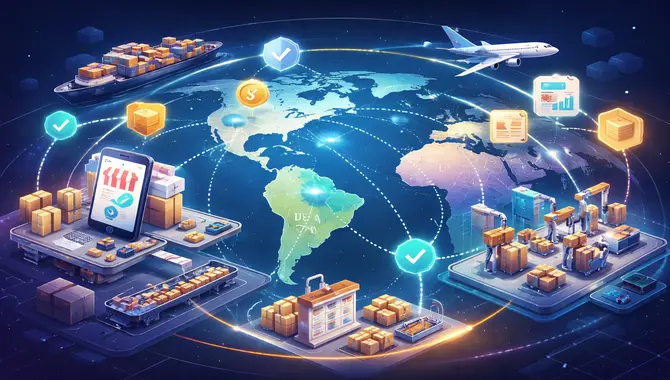
Cross-border ecommerce is growing fast, but logistics complexity is growing faster. As brands expand into new markets, especially between the US and Latin America, the traditional logistics model is reaching its limits. Fulfillment alone is no longer enough. In 2026, the most successful ecommerce companies are shifting from execution-focused logistics to end-to-end orchestration.
This article explores the key logistics trends in cross-border ecommerce that are redefining how modern brands scale internationally.
1. The Shift from 3PL to 5PL: Why Orchestration Matters
For years, ecommerce logistics relied on a fragmented stack: one provider for international shipping, another for warehousing, another for last-mile delivery, and separate vendors for payments, returns, and tax compliance. This model worked at low volumes. It breaks at scale.
The trend is clear: brands are moving from 3PL and 4PL providers toward 5PL orchestration models. Instead of managing multiple vendors, companies are consolidating logistics, payments, compliance, and reporting into a single operational layer.
The reason is not cost, it is control. Fragmentation creates blind spots, operational risk, and slow decision-making. Orchestration reduces friction by aligning all moving parts under one coordinated system.
2. Logistics, Payments, and Tax Are Becoming One System
One of the most underestimated ecommerce logistics trends is the convergence of physical and financial flows. Logistics decisions now directly impact:
- Conversion rates
- Cash flow and working capital
- Fraud exposure
- Customer experience
In cross-border ecommerce, this convergence is even more critical. Payment methods like Cash on Delivery (COD), local payment rails, tax handling, and revenue repatriation are inseparable from fulfillment and returns.
This is why Merchant of Record (MoR) capabilities are becoming a growth enabler rather than a legal afterthought. Brands that treat payments and compliance as part of logistics—not as separate back-office functions—scale faster and with less risk.
Kiki Latam integrates these capabilities as part of its modular and end-to-end logistics services, allowing brands to operate cross-border ecommerce with operational and financial coherence.
👉 Learn more about Kiki Latam’s full service stack here.
3. Cross-Border Fulfillment Is Becoming Regional, Not Global
Another major trend reshaping ecommerce logistics is regionalization.
Instead of shipping everything from a single global hub, brands are moving inventory closer to demand. In Latin America, this means localized fulfillment strategies across markets like Mexico, Colombia, Peru, and the United States.
Why this matters:
- Faster delivery times
- Lower customs friction
- Reduced inventory risk
- Better unit economics
Nearshoring and regional hubs are no longer tactical optimizations—they are strategic advantages. Brands that adapt their logistics model to regional realities outperform those applying a “one-size-fits-all” global approach.
4. Visibility and Data Are the New Logistics Infrastructure
Speed still matters, but visibility matters more.
Modern ecommerce logistics is increasingly driven by real-time data: inventory status, order lifecycle, returns, payment reconciliation, and exception management. Without unified reporting, growth decisions are based on partial or outdated information.
The trend in 2026 is clear: data transparency is replacing speed as the primary differentiator. Brands want to know what is happening across countries, carriers, warehouses, and payment flows, without stitching spreadsheets from multiple vendors.
Logistics platforms that provide centralized reporting and operational visibility are becoming foundational infrastructure for international ecommerce.
5. From Cost Center to Revenue Infrastructure
Perhaps the most important shift is conceptual. Logistics is no longer viewed purely as a cost center. It is now revenue infrastructure.
Delivery experience affects repeat purchases. Payment success affects conversion. Returns management affects lifetime value. In cross-border ecommerce, logistics decisions shape the entire customer journey.
Brands that recognize this are redesigning their logistics stack around orchestration, accountability, and scalability.
The future of cross-border ecommerce logistics is not about faster trucks or cheaper freight. It is about coordination, visibility, and control.
As markets like Latin America continue to grow, the brands that win will be those that move beyond fragmented execution and adopt logistics orchestration as a strategic capability.
If you are evaluating how to scale your ecommerce operations across the US and LATAM without increasing complexity, speaking with an expert can clarify the right model for your business.
👉 Contact a Kiki Latam expert to explore an end-to-end logistics strategy.