
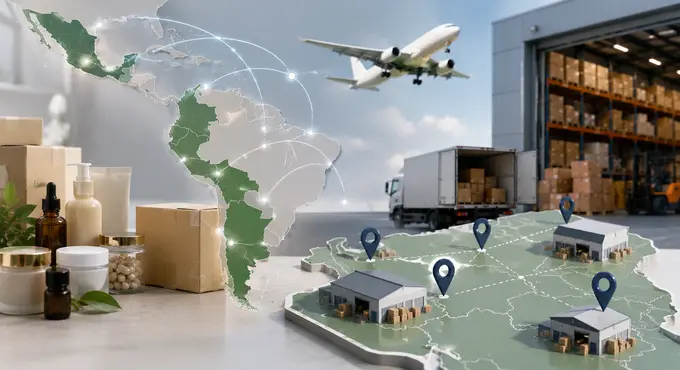
Expanding into Latin America is no longer just about entering one market. Many Nutra and Beauty brands begin with Mexico or Colombia and quickly discover opportunities in Peru, or other countries across the region.
At that point, one question becomes critical:
Where should your inventory be stored?
Should you operate from one centralized warehouse? Open inventory in multiple countries? Ship internationally for every order?
The answer can dramatically impact your delivery times, customer experience, cash flow, and profitability.
Choosing the wrong fulfillment strategy can increase logistics costs long before your marketing campaigns reach their full potential.
Why Inventory Location Matters More Than Most Brands Realize?
Many international sellers focus heavily on customer acquisition.
They optimize advertising campaigns, improve landing pages, and recruit affiliate partners.
But logistics costs often grow faster than sales.
Inventory location affects almost every operational KPI, including:
- Delivery speed
- Shipping costs
- Customer satisfaction
- Return rates
- Cash flow
- Inventory availability
- Working capital
- Scalability
The closer your products are to your customers, the easier it becomes to compete on both price and service.
The Hidden Cost of Centralized Inventory
Many brands initially operate with a single warehouse because it appears simpler.
Inventory is easier to manage.
Forecasting feels more predictable.
Operations remain centralized.
However, as order volumes increase across multiple countries, centralized inventory often creates new challenges.
Products may need to cross borders for every shipment.
International transportation increases costs.
Customs processes add uncertainty.
Delivery times become longer.
Returns become significantly more expensive.
Eventually, what seemed like the simplest solution becomes the most expensive one.
When Centralized Fulfillment Makes Sense?
Centralized inventory can still be the right strategy during the early stages of expansion.
- It generally works well when:
- Testing a new market
- Managing relatively low order volumes
- Launching a limited product catalog
- Validating customer demand
- Running pilot campaigns
Keeping inventory in one location minimizes operational complexity while allowing brands to evaluate market potential before making larger investments.
The key is recognizing when that model no longer supports growth.
When Local Inventory Becomes the Better Choice?
As sales become consistent, local fulfillment begins generating measurable operational advantages.
Warehousing products inside the destination country typically provides:
- Faster deliveries
- Lower last-mile costs
- Fewer customs delays
- Better customer experience
- Lower return expenses
- Improved Cash on Delivery performance
For Nutra and Beauty products, delivery speed often influences customer satisfaction and repeat purchases.
Consumers increasingly expect deliveries within just a few days—not several weeks.
Why One Warehouse Is Rarely Enough for LATAM?
Latin America is not a single logistics market.
Every country has different:
- Import regulations
- Transportation networks
- Consumer expectations
- Delivery providers
- Geographic challenges
- Tax structures
A fulfillment strategy that works perfectly in Mexico may be inefficient in Colombia or Peru.
Successful regional brands design their operations country by country instead of applying one logistics model across the entire region.
Forecasting Inventory Is Just as Important as Storing It
Inventory positioning is only part of the equation.
Brands must also determine how much inventory belongs in each location.
Holding too little inventory leads to stockouts.
Holding too much inventory ties up working capital and increases storage costs.
- Accurate forecasting requires analyzing:
- Historical sales
- Marketing plans
- Seasonality
- Promotional campaigns
- Affiliate activity
- Product launch schedules
The objective is balancing inventory availability with healthy cash flow.
Fulfillment Should Support Marketing Growth
Marketing and logistics should never operate independently.
Imagine launching a successful affiliate campaign that suddenly doubles daily orders.
Can your fulfillment operation scale?
Can warehouses process the additional volume?
Can carriers maintain delivery times?
Can inventory support demand?
Without operational readiness, successful campaigns often create customer dissatisfaction rather than business growth.
The strongest brands align marketing plans with inventory planning long before campaigns go live.
Technology Makes Multi-Country Fulfillment Manageable
Managing inventory across several countries once required multiple systems and extensive manual coordination.
Today, integrated logistics technology allows businesses to maintain visibility across regional operations.
Modern fulfillment platforms provide:
- Real-time inventory tracking
- Order management
- Warehouse synchronization
- Carrier selection
- Shipment visibility
- Inventory reporting
- Performance analytics
Instead of managing separate logistics operations in every country, businesses can coordinate multiple markets through one connected ecosystem.
A Multi-Country Strategy Doesn’t Mean More Complexity
Many businesses hesitate to distribute inventory because they assume operations will become harder.
Ironically, the opposite is often true.
Properly distributed inventory reduces operational friction.
Orders travel shorter distances.
Deliveries become more predictable.
Returns are processed locally.
Customer service improves.
Transportation costs decrease.
Operational complexity shifts from reacting to logistics problems toward proactively managing growth.
The Most Successful Brands Scale Gradually
There is no universal fulfillment strategy for every Nutra or Beauty business.
Some brands succeed with one warehouse.
Others benefit from regional distribution.
- The best approach depends on:
- Sales volume
- Product portfolio
- Target countries
- Delivery expectations
- Cash flow
- Growth plans
Rather than opening warehouses everywhere simultaneously, successful companies expand fulfillment capacity as demand justifies it.
This staged approach minimizes financial risk while maintaining operational flexibility.
Final Thoughts
Choosing where to position inventory is one of the most important strategic decisions for any Nutra or Beauty brand expanding into Latin America.
The right fulfillment network reduces costs, shortens delivery times, improves customer satisfaction, and creates the operational foundation required for sustainable growth.
The goal isn’t simply storing products closer to customers.
It’s building a logistics network capable of supporting your business as it expands across multiple countries.
When inventory is positioned strategically, every marketing dollar works harder—and every delivery strengthens your competitive advantage.
Ready to Build a Smarter Fulfillment Strategy for LATAM?
Kiki LATAM helps international Nutra and Beauty brands optimize inventory placement through multi-country fulfillment, warehousing, inventory management, Cash on Delivery operations, last-mile delivery, and integrated logistics across Mexico, Colombia, Peru, and the United States.
Speak with one of our logistics specialists today and discover the best fulfillment strategy for scaling your business across Latin America.