
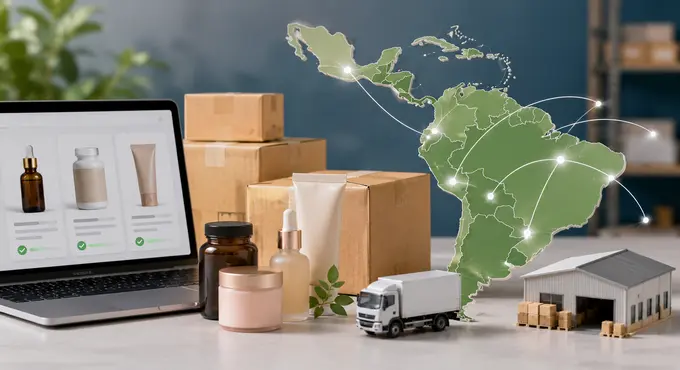
Expanding into Latin America no longer requires making a massive upfront investment.
Just a few years ago, entering markets like Mexico or Colombia often meant establishing a local legal entity, opening bank accounts, negotiating with multiple logistics providers, and building an operational team before selling a single product.
Today, the smartest Nutra and Beauty brands take a very different approach.
Instead of investing heavily before validating demand, they test the market first, scale second.
This strategy allows companies to measure product-market fit, optimize acquisition costs, and validate logistics before committing significant capital.
If you’re considering launching your products in Latin America, here’s how to do it without creating unnecessary operational complexity.
Why Testing Before Scaling Matters
Many international brands assume that entering a new country requires a full market launch.
They import large quantities of inventory.
They establish local operations.
They hire personnel.
They invest heavily in advertising.
Only afterward do they discover whether customers actually want the product.
That approach creates unnecessary financial risk.
A structured market test allows businesses to answer critical questions first:
Does the product convert?
Which country responds better?
Which customer segment performs best?
Which advertising channels are most profitable?
Is Cash on Delivery increasing conversions?
What is the real customer acquisition cost?
Answering these questions early reduces expansion risk dramatically.
Start With One Market—Not the Entire Region
Latin America is often discussed as a single market.
Operationally, it isn’t.
Consumer behavior, logistics networks, payment preferences, and regulations differ significantly between countries.
Rather than launching across five countries simultaneously, successful brands usually begin with one strategic market.
For Nutra and Beauty, Mexico and Colombia are often attractive starting points because they combine:
Large consumer populations
Strong eCommerce growth
High Cash on Delivery adoption
Active affiliate ecosystems
Growing demand for imported products
Testing one market provides valuable operational data before expanding regionally.
Keep Your Initial Inventory Lean
One of the biggest mistakes companies make is importing excessive inventory before validating demand.
Large inventory positions increase:
Capital requirements
Warehousing costs
Forecasting risk
Product expiration exposure
Operational complexity
Instead, successful brands begin with inventory sized specifically for testing.
The objective isn’t maximizing sales immediately.
It’s gathering reliable market intelligence.
Once advertising performance and customer demand become predictable, inventory levels can scale accordingly.
Focus on Measuring the Right Metrics
Many businesses evaluate market tests using only sales volume.
That approach overlooks the operational factors that determine long-term profitability.
A successful test should measure:
- Conversion rate
- Cost per acquisition
- Average order value
- Cash on Delivery acceptance rate
- Delivery success rate
- Return rate
- Customer satisfaction
- Time to delivery
- Repeat purchase potential
Together, these KPIs provide a much more accurate picture of market viability than revenue alone.
You Don’t Need Local Infrastructure to Validate Demand
Modern cross-border logistics solutions allow international brands to launch without building every operational component internally.
Instead of managing multiple providers, businesses can leverage integrated logistics services that support:
- Inventory storage
- Cumplimiento
- Contra reembolso
- Order confirmation
- Entrega en el último kilómetro
- Reverse logistics
- International payment reconciliation
This significantly reduces the operational barriers that traditionally prevented smaller brands from entering Latin America.
Why Cash on Delivery Changes the Testing Strategy
Cash on Delivery (COD) remains one of the strongest competitive advantages for many Nutra and Beauty brands entering LATAM.
Consumers who hesitate to prepay online are often much more willing to complete an order when payment occurs at delivery.
For testing purposes, COD provides valuable insights into actual customer demand.
However, successful testing requires more than simply offering COD.
Brands should also monitor:
- Order confirmation rates
- Delivery completion rates
- Refusal rates
- Collection efficiency
These operational indicators help determine whether scaling the business will remain profitable.
Use Marketing to Learn—Not Just to Sell
The first campaigns should be treated as market research.
Different creative angles, audiences, and offers can reveal valuable customer insights.
Questions worth testing include:
Which products generate the strongest demand?
Which price points convert best?
Which bundles increase average order value?
Which messaging resonates with local consumers?
Which affiliate traffic performs best?
Every campaign provides data that improves future expansion decisions.
Scale Only After Operations Become Predictable
The goal of a successful market test isn’t rapid growth.
It’s operational confidence.
Once businesses understand customer acquisition costs, fulfillment performance, logistics costs, and customer behavior, scaling becomes significantly less risky.
At that stage, companies can confidently:
- Increase advertising budgets
- Expand inventory
- Enter additional countries
- Launch new product lines
- Add fulfillment locations
Growth becomes a calculated decision rather than a gamble.
The Right Logistics Partner Accelerates Market Validation
Testing a new country becomes much easier when logistics infrastructure is already in place.
An experienced regional logistics partner can provide:
- Warehousing
- Cumplimiento
- Inventory management
- Order confirmation
- Cash on Delivery operations
- Entrega en el último kilómetro
- Returns management
- Operational reporting
Instead of spending months building local operations, brands can focus on validating demand and optimizing marketing performance.
Final Thoughts
Expanding into Latin America doesn’t have to begin with a major investment.
The most successful Nutra and Beauty brands validate demand first, optimize operations second, and scale only after they understand the economics of the market.
By starting with a focused test, lean inventory, integrated logistics, and measurable KPIs, businesses reduce financial risk while building a stronger foundation for long-term growth.
The smartest expansion strategy isn’t entering every market immediately.
It’s entering the right market the right way.
Ready to Test Your Nutra or Beauty Business in LATAM?
Kiki LATAM helps international brands launch and validate new markets through integrated fulfillment, warehousing, Cash on Delivery, order confirmation, last-mile delivery, and cross-border logistics across Mexico, Colombia, Peru, and the United States.
Talk to one of our logistics specialists today and discover how to test your business in Latin America without unnecessary operational complexity,