
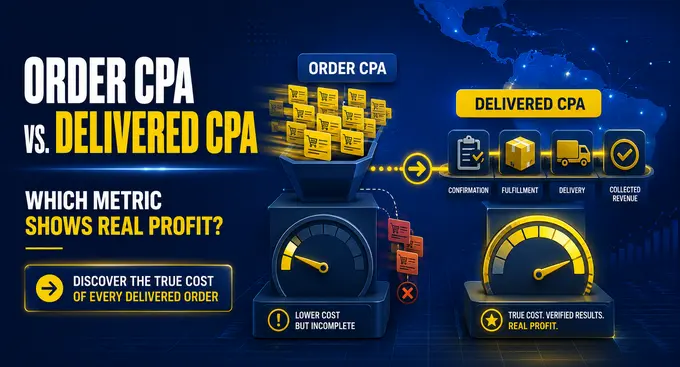
In affiliate marketing, Cost per Acquisition is often treated as the clearest measure of campaign performance. Divide advertising or affiliate spend by the number of orders and you have Order CPA. If that number is below the expected margin, the offer appears profitable.
For Cash on Delivery offers, however, this calculation can be dangerously incomplete.
A submitted order has not yet produced revenue. It must be confirmed, fulfilled, delivered and paid. Orders that are cancelled, rejected, fraudulent or returned to origin still consume operational resources. Measuring only Order CPA can therefore make an unprofitable campaign look ready to scale.
The metric that matters is Delivered CPA: the acquisition cost for each order that reaches the customer and generates collected revenue.
What Is Order CPA?
Order CPA measures how much it costs to generate an order:
Order CPA = Total acquisition spend ÷ Orders generated
If a campaign spends USD 10,000 and generates 1,000 orders, its Order CPA is USD 10. This metric helps compare traffic sources, creatives and landing pages.
But it stops at the checkout. It does not reveal whether the customer confirmed the purchase, whether the address was deliverable or whether payment was collected.
In prepaid e-commerce, the gap between an order and revenue may be relatively small. In COD affiliate marketing, that gap is an entire operational funnel.
What Is Delivered CPA?
Delivered CPA measures acquisition cost against completed deliveries:
Delivered CPA = Total acquisition spend ÷ Successfully delivered orders
Using the same example, suppose only 600 of the 1,000 orders are delivered and collected. Order CPA remains USD 10, but Delivered CPA rises to USD 16.67.
That difference changes the economics before fulfillment, last-mile, returns or product costs are considered. A campaign optimized around delivered orders can identify which affiliates, creatives and GEOs produce actual revenue.
At Kiki LATAM, we help CPA networks and Offer Owners connect acquisition data with confirmation, fulfillment, delivery and collection across Latin America.
Why Order CPA Can Hide Losses
Several factors can separate a registered COD order from a collected sale: unsuccessful confirmation, inaccurate addresses, cancellation, slow delivery, buyer unavailability, fraud or refusal at the door. A parcel may return after fulfillment and last-mile costs have already been incurred.
These failures are not visible in the advertising platform’s conversion column. Without downstream data, teams may increase budgets for the campaign with the cheapest orders while reducing investment in a more expensive source that delivers better customers.
Measure the Entire COD Funnel
Delivered CPA should not be evaluated alone. Offer Owners need a connected set of metrics:
Confirmation rate
The percentage of generated orders validated with the customer. A low rate may indicate weak intent, inaccurate contact information or misleading advertising.
Delivery rate
The percentage of dispatched orders successfully delivered. It reflects address quality, delivery speed, carrier performance, communication and rescheduling.
Return-to-Origin rate
The percentage of dispatched parcels that return without generating collected revenue. RTO directly increases the real cost of every successful sale.
Offer Owners should also track whether COD funds were reconciled and made available for settlement. Together, these metrics show where margin disappears between the affiliate click and usable revenue.
Calculate Profit per Delivered Order
Delivered CPA is more accurate than Order CPA, but it is still only an acquisition metric. Real offer profitability must include the full variable cost of delivering and collecting the sale:
Profit per delivered order = Collected revenue − product cost − Delivered CPA − confirmation − fulfillment − last-mile − RTO allocation − payment and settlement costs
RTO allocation is essential. Failed outbound and return shipment costs should be distributed across successful deliveries or reported margin will remain overstated.
Segment this calculation by affiliate, campaign, product, country and carrier. Blended averages can hide profitable traffic or regional operational problems.
How to Improve Delivered CPA
Reducing Delivered CPA does not always mean finding cheaper traffic. It can also mean converting more existing orders into collected sales through:
- Fast multilingual order confirmation.
- Address validation before fulfillment.
- Local inventory and shorter delivery times.
- Carrier selection based on destination and historical performance.
- Delivery notifications and proactive customer communication.
- Rescheduling after unsuccessful attempts.
- Affiliate reporting based on delivered, not merely submitted, orders.
Improving delivery rate from the same acquisition volume lowers Delivered CPA without requiring additional media spend.
Build a COD Operation Around Delivered Profit
Kiki LATAM integrates order confirmation, address validation, warehousing, fulfillment, smart carrier assignment, last-mile delivery, rescheduling, COD collection and international settlement in Mexico, Colombia, Peru and the United States.
This gives CPA networks and Offer Owners visibility beyond the order, helping them identify campaigns that generate delivered revenue and scale using real business results.
Order CPA tells you how effectively you generate orders. Delivered CPA tells you how effectively those orders become revenue. Profit per delivered order tells you whether the offer is worth scaling.
If you want to evaluate the real profitability of your COD offer in Latin America,
🔆 Contact Kiki Latam.
We can assess your target market, product, volume and post-checkout operation.
- Etiquetas:
- Affiliate Marketing Metrics ,
- Affiliate Performance ,
- Campaign Optimization ,
- Contrareembolso,
- COD Affiliate Marketing ,
- COD fulfillment ,
- COD Metrics ,
- Confirmation Rate ,
- Cost per Acquisition ,
- Cost per Delivered Order ,
- CPA Networks ,
- Delivered CPA ,
- Delivery Rate ,
- E-commerce Profitability ,
- Kiki LATAM,
- last-mile delivery ,
- LATAM e-commerce ,
- Logistics in Latin America ,
- Offer Owners ,
- Offer Profitability ,
- Order Confirmation ,
- Order CPA ,
- Profit per Delivered Order ,
- Return to Origin ,
- RTO