
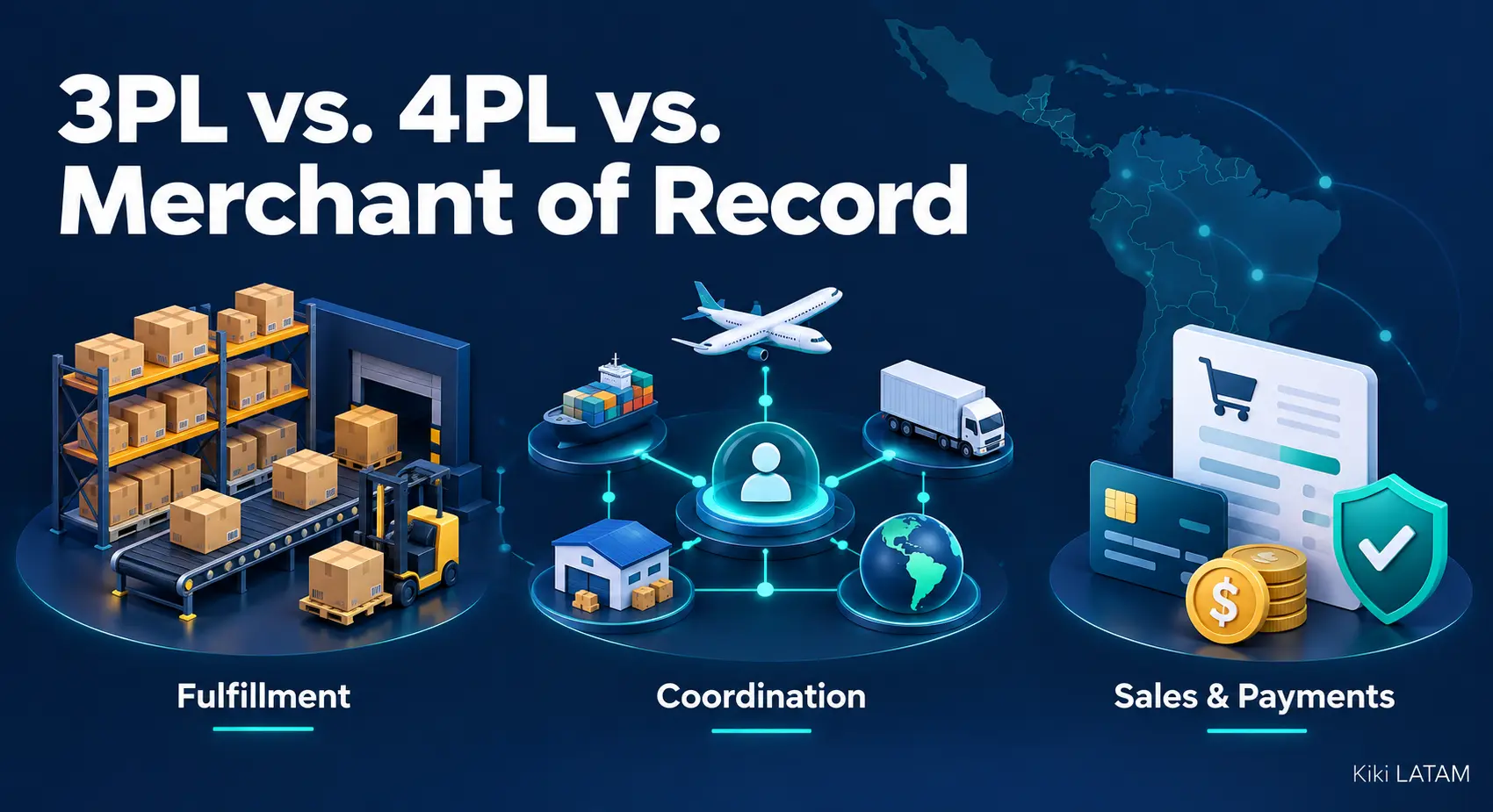
Expanding into Latin America requires several connected capabilities: products must reach customers, logistics providers must work together, and every sale needs clearly assigned commercial and financial responsibilities.
For international CPA businesses, affiliate advertisers, and direct-to-consumer brands, understanding 3PL, 4PL, and Merchant of Record (MoR) helps build an operation that supports growth.
These services address different needs and can work together. The right combination depends on your markets, products, existing infrastructure, and the responsibilities you want to delegate.
3PL: Executing Your Logistics Operation
A third-party logistics provider, or 3PL, performs outsourced logistics activities. These commonly include receiving goods, storing inventory, picking and packing orders, dispatching shipments, and handling returns.
The Council of Supply Chain Management Professionals identifies transportation, warehousing, inventory management, and order fulfillment among the activities within logistics management.
For a CPA business, these capabilities connect customer acquisition with order execution. Advertising generates demand; fulfillment turns that demand into prepared shipments.
When evaluating a 3PL, look beyond the price per package. Check inventory accuracy, dispatch times, peak capacity, returns procedures, and integration with your order management system.
For cash-on-delivery operations, establish whether payment collection is included, who performs it, and how collection records connect to individual orders.
A 3PL’s logistics role does not automatically make it the seller, taxpayer, or importer for your products.
4PL: Coordinating the Logistics Network
A fourth-party logistics provider, or 4PL, takes a broader coordination role. Depending on the agreement, it manages multiple logistics providers, supports planning, monitors performance, and creates visibility across the network.
This becomes valuable when a business operates across countries, warehouses, and delivery partners.
Consider a brand expanding into Mexico, Colombia, and Peru. Each market may involve different inventory locations, transport providers, delivery conditions, and reporting processes. A coordination partner can help connect those activities and resolve issues across the operation.
Evaluate that capability through practical questions:
- Can you compare performance across markets?
- Who resolves problems involving multiple providers?
- Can you trace the costs associated with each order?
- How are inventory movements and carrier changes decided?
A clear coordination model can reduce administrative work and support better decisions. Its effectiveness depends on the authority, information access, and responsibilities established in the contract.
Merchant of Record: Managing Responsibilities Around the Sale
A Merchant of Record assumes defined responsibilities for the transactions covered by its service. These may include payment processing, sales documentation, applicable transaction taxes, reconciliation, refunds, and payment disputes.
For physical products, verify the precise scope. Some MoR services support only digital goods, while others accommodate particular physical product categories and countries.
Ask which entity appears as the seller, issues the relevant receipt or invoice, handles transaction taxes, and manages consumer payment issues.
Local requirements matter. For example, SUNAT explains Peru’s electronic sales receipt system, illustrating why collecting a payment and documenting a sale require coordinated processes.
A MoR arrangement can simplify commercial administration, while product quality, permits, and other obligations may remain with the brand.
Keep COD Collection and Import Responsibilities Clear
In a COD operation, the party collecting payment at delivery may be acting on behalf of another entity. Collection alone does not establish who is the seller or Merchant of Record.
Your operation should distinguish between an order being delivered, its payment being collected, and the resulting balance being settled to your business.
Import responsibilities also need a separate review. A logistics provider or MoR may offer import support, but that role must be explicitly confirmed.
Mexico’s SAT publishes requirements for its importer registration system. The International Chamber of Commerce also explains that local restrictions can affect a foreign seller’s ability to perform import formalities under DDP.
Before launch, identify the responsible entity for customs clearance, product documentation, and applicable import charges.
Choose the Combination Your Business Needs
If your commercial structure is established and you need fulfillment, a 3PL may address the immediate gap.
If multiple providers and markets create coordination problems, evaluate a broader logistics management model.
If you need support with the commercial administration of local transactions, assess an MoR arrangement alongside your logistics requirements.
For CPA businesses, compare the total operational cost against completed, collected sales. Include failed deliveries, returns, payment fees, currency conversion, and settlement timing when evaluating profitability.
Connect Your Expansion Through Kiki LATAM
Kiki LATAM offers a modular approach that connects fulfillment, transportation, COD collection, and commercial services according to the operation’s needs.
Its published terms describe MoR services covering payment processing, invoicing, tax compliance, and reconciliation where available. They also identify responsibilities retained by the client, including product quality and required documentation.
That clarity helps businesses define their operating structure before scaling campaigns.
Speak with a LATAM logistics expert at Kiki to assess your markets, products, and payment model—and identify the services your expansion requires.